
NAU MAI, HAERE MAI
KI NGĀ PŪ KŌRERO
Welcome to Ngā Pū Kōrero, our publication celebrating the incredible creativity, people, and mātauranga that make our rohe so special.
HŌTOKE 2026
-
Our ringatoi are the storytellers of our people. Through their creative expressions, they capture and reflect who we are, our kōrero, our tikanga, our whakapapa and our aspirations. Tēnā koutou i wā koutou mahi hei painga mō te iwi
Puanga and Matariki have brought a renewed energy to Toi Ngāpuhi. We are excited about the kaupapa ahead and the opportunities the next six months hold for our ringatoi and communities across Ngāpuhi-nui-tonu. Here is an update on some of our key priorities over the next few months.
Following an inspiring weekend at Te Hui Raranga o Te Tai Tokerau, we are thrilled to continue supporting Te Tira Ranga with a second hui to be held at Roma Marae in Ahipara followed by a raranga exhibition in Whangārei . We acknowledge our pūkenga, Whaea Te Hemoata Henare, Mākuini Cherrington and Makareta Jahnke, whose vision has grown Te Tira Ranga and who continue to lead this kaupapa with dedication, generosity and excellence.
Our whakairo kaupapa is also continuing to grow. Te Wharau Whakairo successfully hosted its first Wāhine Whakairo Workshop in May, creating a space for wahine to connect, learn and share. Building on that success, planning is now underway for a dedicated wānanga that will continue to strengthen opportunities for wahine carvers across our rohe to develop their practice, share knowledge and support one another.
Tai o Hī, Tai o Hā is underway, and we are looking forward to welcoming the newest cohort into our programme. This kaupapa aims to support emerging Ngāpuhi-nui-tonu artists by offering them opportunities to strengthen their skills and learn our unique toi traditions; it also offers them an environment to explore a range of creative practices.
Behind the scenes, our Paerangi (Board) continues to invest in the future of Toi Ngāpuhi. We are pleased to share that Creative New Zealand has approved funding to support governance development, ensuring our directors continue to build the skills, knowledge and capability needed to lead our organisation with confidence and vision.
As we move forward into this next season, we acknowledge and celebrate everyone who contributes to the growth of Ngāpuhi toi. Together. E mihi nui ana ki ngā ringatoi, ki ngā whānau, ki ngā kaitautoko, everyone who continues to walk alongside our kaupapa; it doesn’t go unnoticed
He toi nō Hawaiki, he toi mā ngā uri, he toi Ngāpuhi.Nā, Gail Richards
Kaiwhakahaere Matua
RECLAIMING THE CHISLEL
Toi Whakairo
-
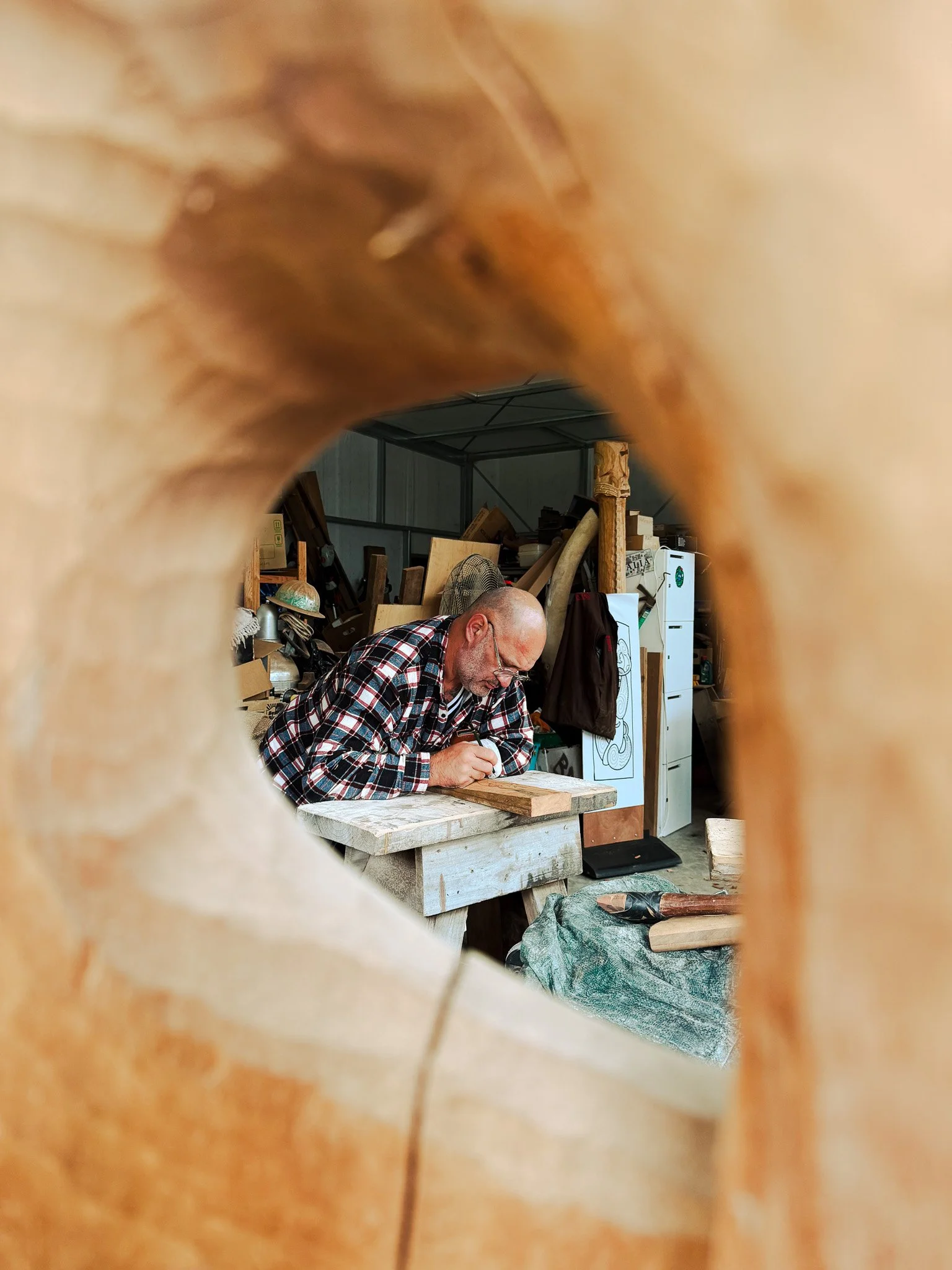
Scroll through Instagram or TikTok today, and you’ll see a massive wave of Māori carving. Kaiwhakairo are flexing their latest taonga, sharing tool hacks, and selling custom pieces for 21st birthdays or farewell gifts. It’s inspiring to see the art form alive and thriving in the digital age.
But while personal creativity is buzzing online, an important question remains: how do these individual creative pursuits connect back to our hapū, our marae, and our ancestral identity?
Enter Te Toi Whakairo—one of Toi Ngāpuhi’s foundation strategic programmes aimed at blending and sharpening technical skills with the raw aspirations of hapū to build, carve, and weave their own whare moko (carved and woven meeting houses). It’s about taking whakairo out of abstract spaces and putting it back into the hands of marae, guided by the twin pillars of mana motuhake and tino rangatiratanga.
-
For the past 120 to 150 years, much of what we know about carving styles has been filtered through academic lenses. Take the distinctive serpentine carving style of Te Tai Tokerau, for instance. Mainstream academia accepted it as standard, yet often overlooked the deep pūrakau (stories) explaining why it developed uniquely here compared to places like Taranaki or Hauraki.
By the 1970s and 80s, formal carving education shifted toward standardized NZQA qualifications under tertiary institutions. While this produced highly proficient carvers, it also outsourced tribal carving knowledge to external classrooms. Why? Because polytechs and universities had the funding and people that hapū and marae simply didn't.
To bridge this gap, Toi Ngāpuhi has stepped up to offer an alternative: moving beyond rigid institution-led qualifications so kaiwhakairo can explore carving through the lens of their own hapū authority.
-
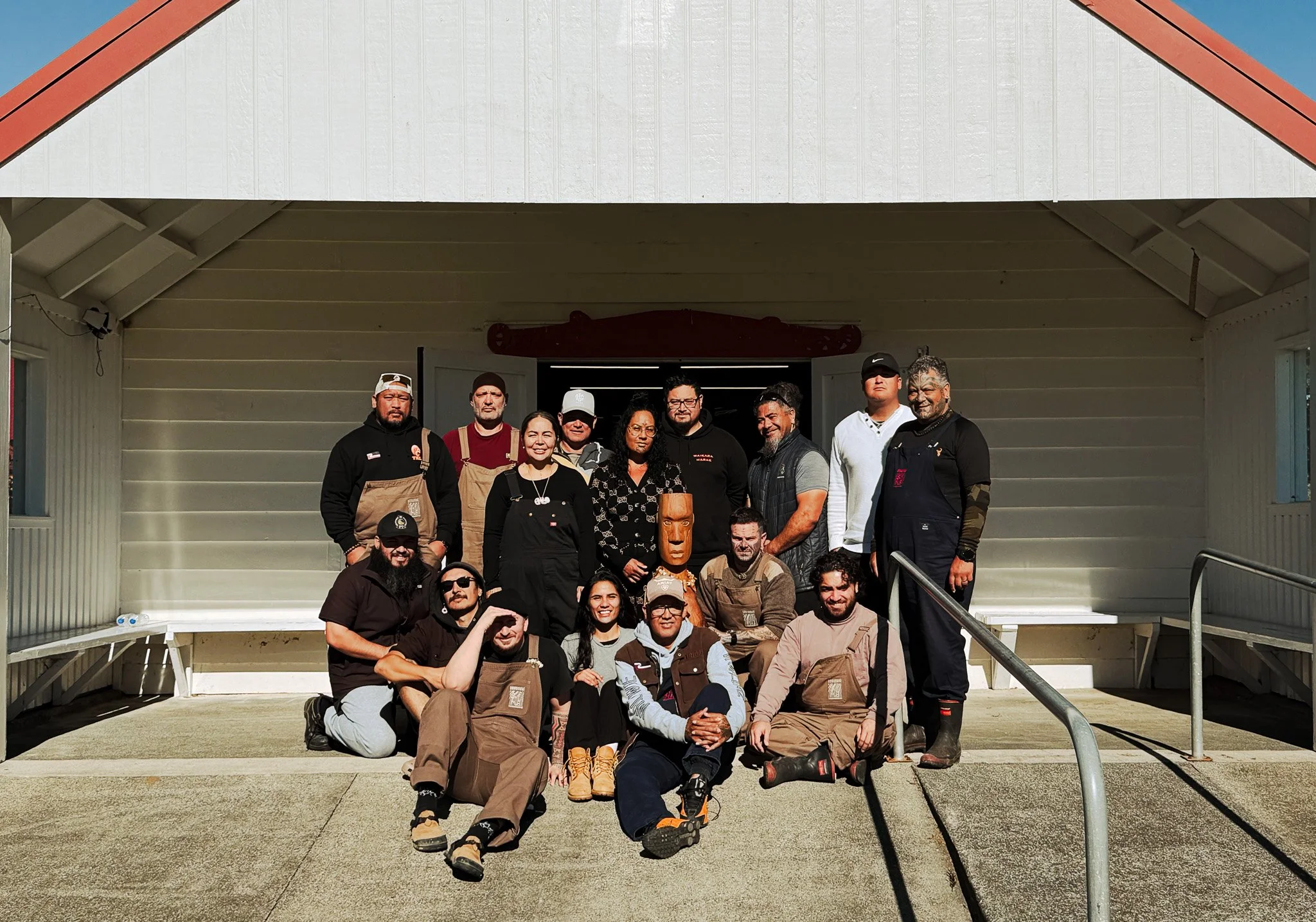
To support carvers—whether tertiary-trained or self-taught—the Wharau Whakairo initiative was established. Think of a wharau as a shelter: a safe space for carvers to gather, talk shop, trade techniques, and navigate the real-world challenges of the craft. More importantly, it acts as a collective launchpad to support marae communities rebuilding or refurbishing their ancestral whare.
Excitingly, this movement is expanding with the development of Wāhine carvers—a dedicated time and space for the wāhine carvers of today. Historically, wahine who carved faced mixed opinions and cultural debate. Wharau Wāhine creates a supportive environment to address those challenges directly. The goal? To one day deploy all-wāhine or fully integrated carver and weaver teams to build whare moko under the guidance of their hapū communities.
-
To understand where you fit in this landscape, it helps to understand two distinct concepts:
● Toi Auaha: This creativity is individual artistic freedom, personal flair, and modern innovation. It’s the space where a creative explores their own vision without being bound by strict hapū obligations. It’s perfect for personal projects, modern art, and self-expression.
● Toi Whakairo: Toi Whakairo creativity is balanced with atuatanga, whakapapa and tūrangawaewae obligations and benefits. Toi Whakairo isn't just about making art; it’s about grounding a hapū’s tūrangawaewae through their tūpuna—their standing place of power and dignity—by building a whare moko designed by the hapū, for the hapū.
Whether you're picking up a chisel for the first time, studying at an institution, or just admiring taonga on your feed, your practice carries potential. Individual creativity (Toi Auaha) is vital, but when brought under the wing of Te Toi Whakairo, it becomes a powerful tool for cultural sovereignty.
By grounding technical excellence in true hapū aspirations, our generation isn't just carving wood—we’re carving out our self-determination for generations to come.
Tena koutou, Pena Makoare, Hori Te Tai, Hinerangi Himiona
Carving the Future
INSIDE THE PRACTICE
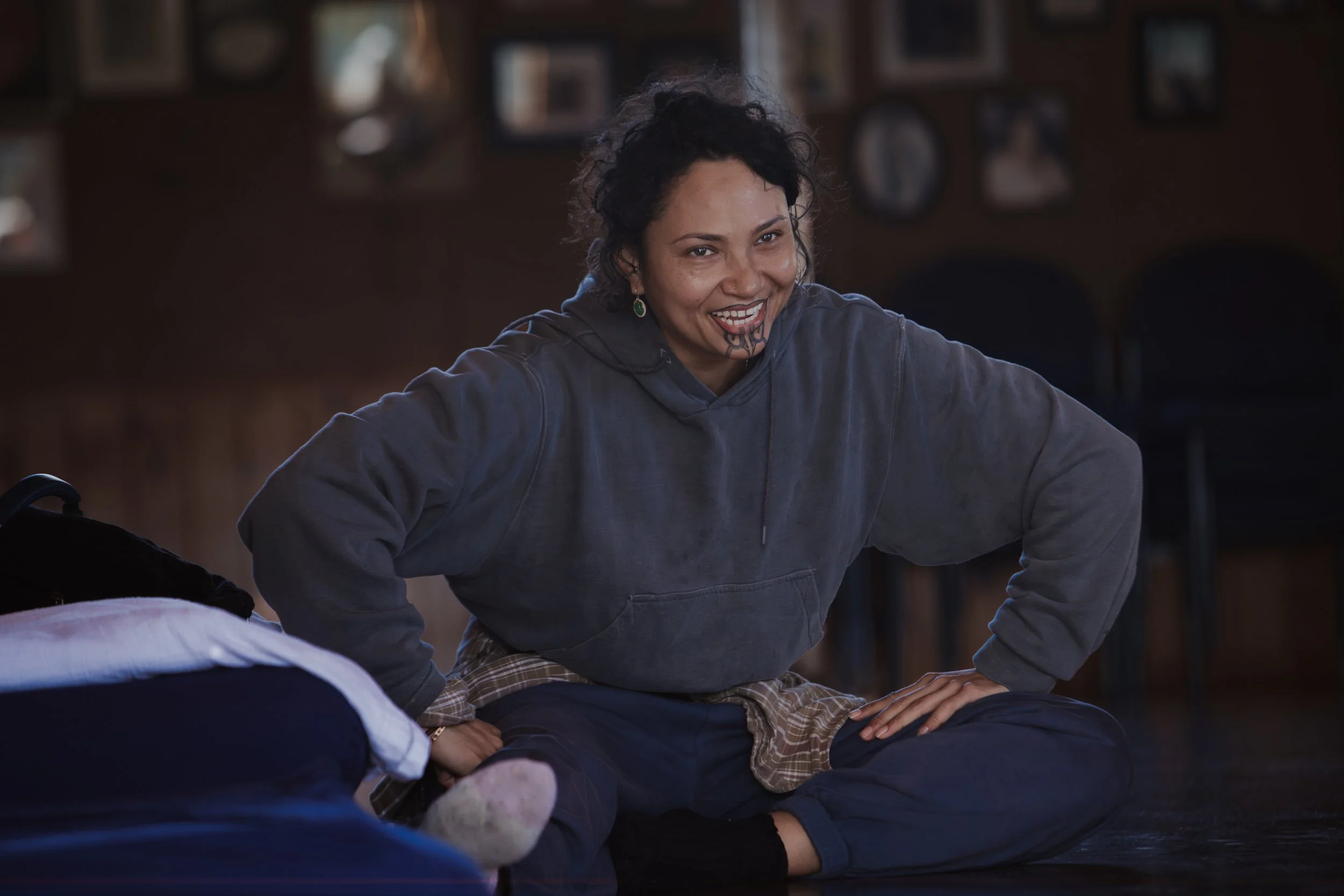
Bella Rose Waetford

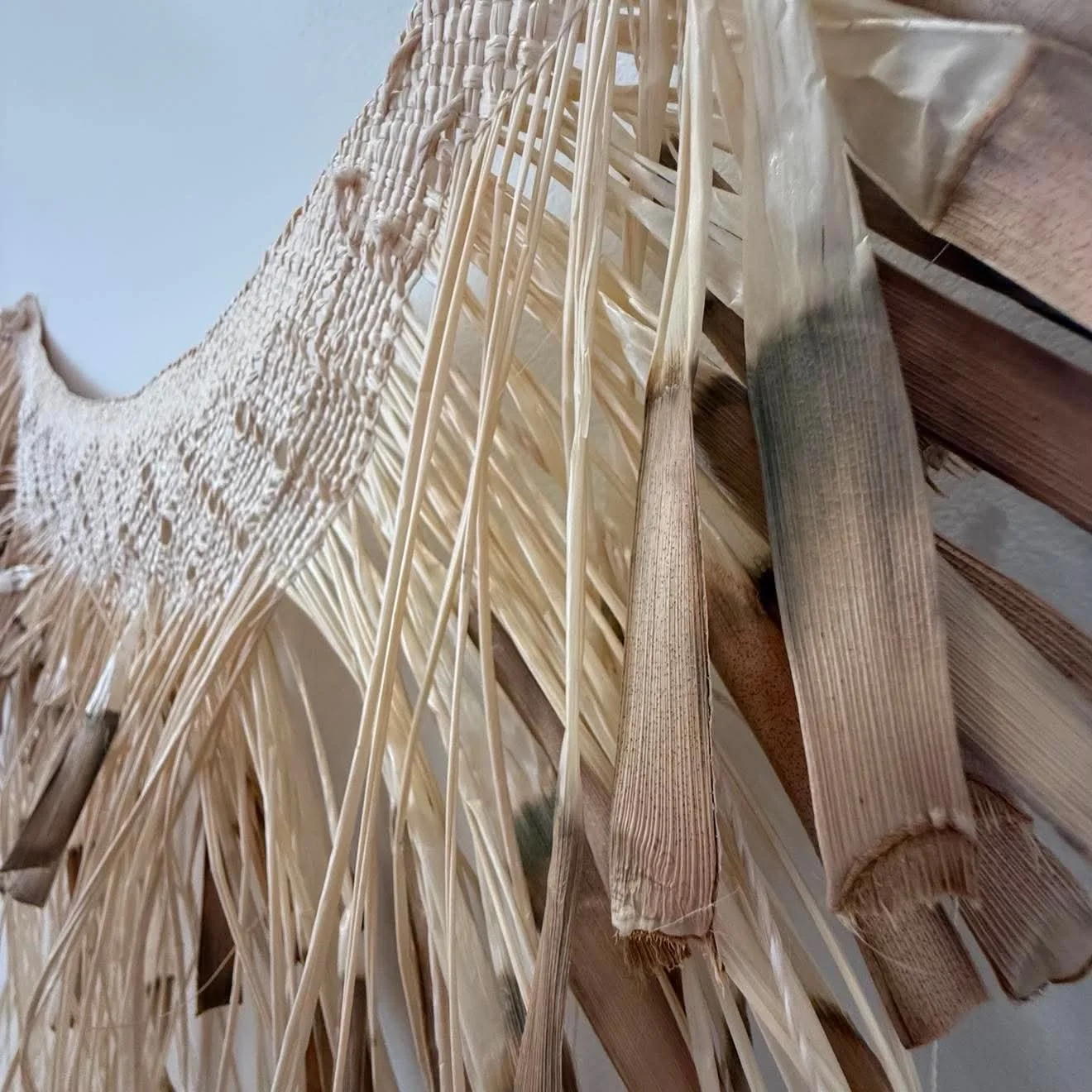
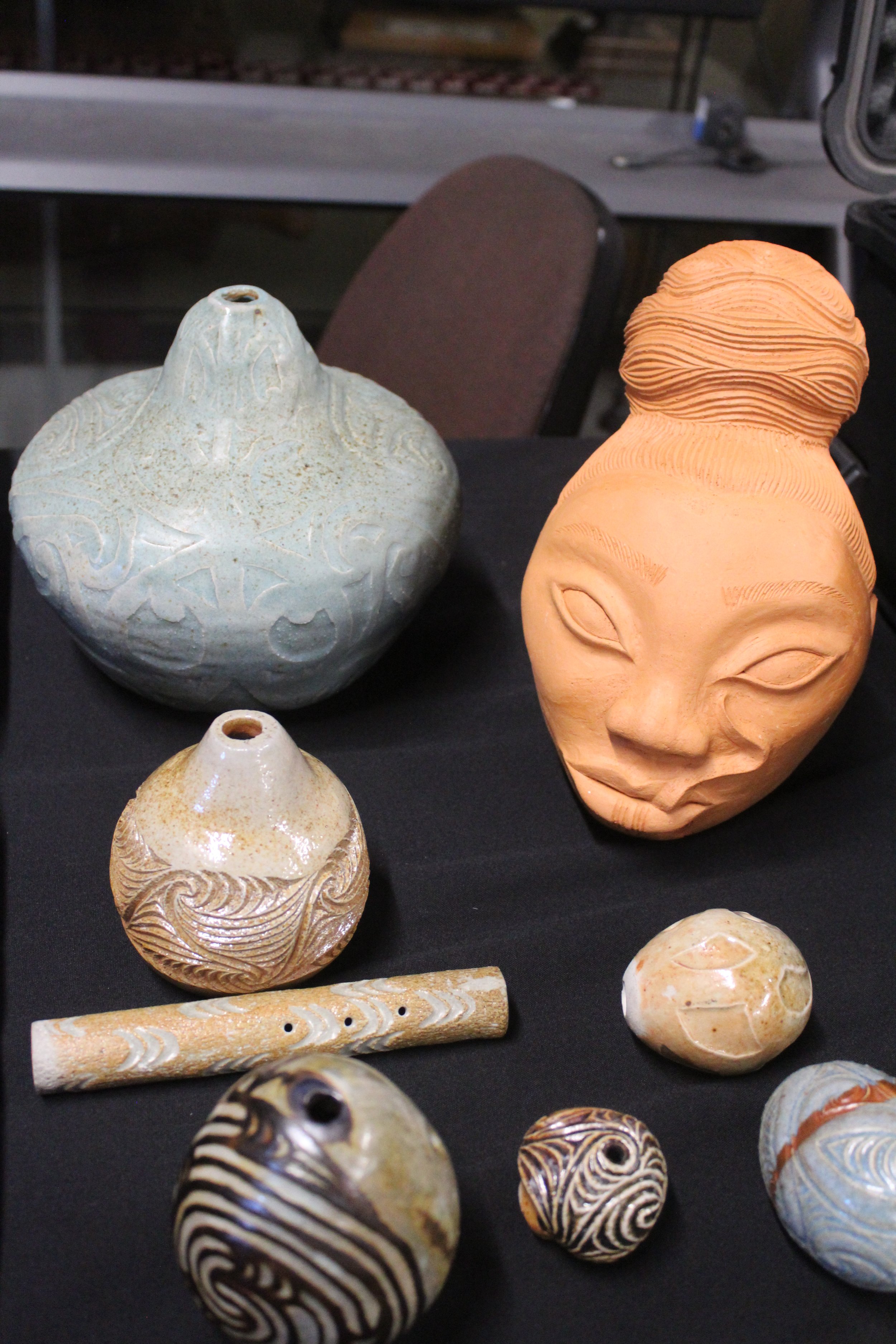
BELLA-ROSE'S WORK FROM TAI O HĪ TAI O HĀ 2024
PHOTOGRAPH BY TE RAWHITIROA BOSCH
Hēnā, whakamōhiotia mai ki te iwi nei, ko wai koe? nō hea koe?
Ki te taha o tōku māmā, ko Ngāti Hine ki uta, Ngāti Wai ki tai. I tipu ake au ki Te Tai Tokerau, ki te pito o te ākau roa o Ngāti Wai, arā, ko Matapōuri rāua ko Whananaki. Ki te taha o tōku pāpā, nō ngā moutere o Te Moana Nui a Kiwa, Vavaʻu, Hāmoa, rātou ko Pukapuka.
Tokorua āku kōtiro, ko Soleyra rāua ko Kahukura. Ko Bella Rose Waetford ahau.
Bella Rose Waetford is an emerging visual artist, born and raised in Te Ākau Roa o Ngātiwai. Here, she reflects on her kāinga, upbringing and how reciprocity guides her practice and her hopes for generations to come.
-
I feel like I was born into it. Ko tōku māmā he ringatoi, he mema hoki nō Ngā Kaihanga Uku. I tīmata ia ki te ako i NorthTec, i te wā tonu e kīa ana ko Polytech. Ko Manos Nathan rāua ko Colleen Urlich ōna pouako. Ko Dorothy Waetford tōna ingoa, ka noho hoki ia ki te paerangi o Toi Ngāpuhi.
I myself didn’t really start practicing until I had my own pēpi. I was never able to stick to one thing because I would get bored easily, but toi is endless. It has kept my attention and created an obsession, you could say. I just want to learn it all. Which is why I applied for the second round of Tai o Hī Tai o Hā. That was just a taster into something I already had within me! And then I really wanted to really sink my teeth in to Toi Māori, so currently I’m studying a Bachelor of Māori arts at Maunga Kura Toi.
-
I was about three, when my mother started her degree, (I think) so I just remember always being surrounded by ringatoi and all the different mediums of toi.
-
I love uku and applying the lessons I have learnt through whakairo to the uku. Uku is more ngāwari and forgiving than working with rakau. At this moment I’m loving learning and putting my hand to natural fibres and using materials that have been sourced from my kāinga and creating works.
-
To me, being tutu is about being in touch with your inner child. Tamariki aren’t afraid to create. They know no boundaries, don’t overthink, and they play with everything and anything. To me, this is what makes creation fun.
As long as you stay within the tikanga of your practice, do the research, so you know what you are creating, then its tika and pono…so you know, have fun!
-
The biggest thing I have learnt is tuku atu, tuku mai. Giving back to your whānau, your hapū and iwi. Giving back to your hapori.
Don’t be a taker, be a giver. There has to be reciprocity. If knowledge, time, support and opportunities have been given to you, then you have a responsibility to think about how you can give that back.
That is something I have been taught throughout my years at Maunga Kura Toi. In any way you can contribute to your hapori, hapū or iwi, do it.
-
My kāinga is a huge source of inspiration for me. Growing up in Matapōuri, surrounded by the whenua, moana, whānau and kōrero has naturally influenced the way I see and make things.
I continue to bring this into my mahi, not just making things for the sake of making them but creating from a place of connection.
-
For me, toi is a connector for people, to bring them back to their whānau, whenua and whakapapa. I think about what I have been taught — tuku atu, tuku mai.
The knowledge I receive isn't just for me. It is something I can take back and share.
-
My aspirations are to be able to keep sharing and learning through wānanga for my hapū and iwi. Once I have finished my studies, I would like to contribute to the kōhanga and kura kaupapa by working alongside the kaimahi and tamariki.
I hope that my babies follow my path, just as I have followed my māmā's. I want them to grow up surrounded by these practices and to know that they have a place within them.
Ultimately, I want to keep learning so that I can give back. Tuku atu, tuku mai.
NZFW KAHURIA 2026
Kāhui Collective & KOHI:
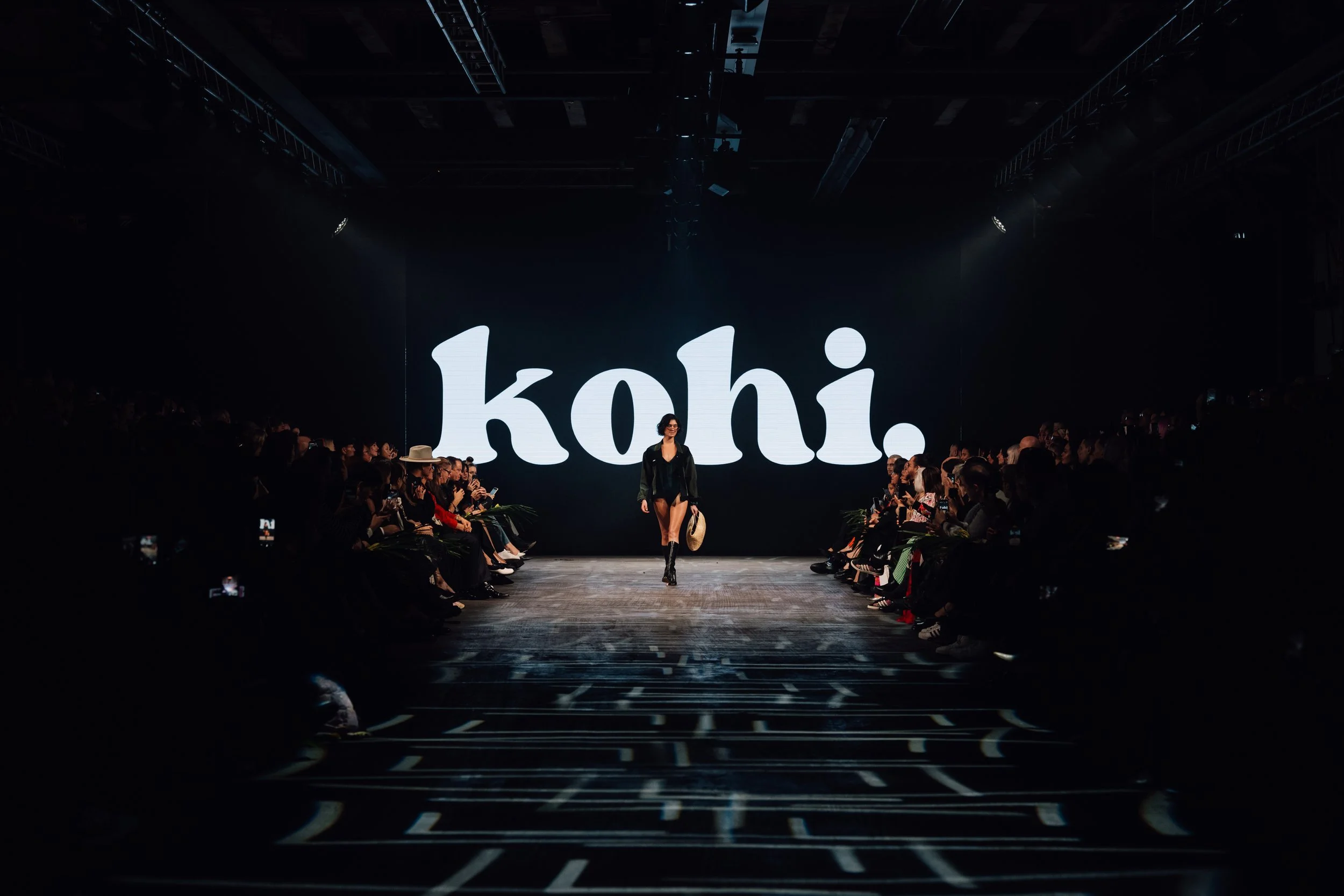
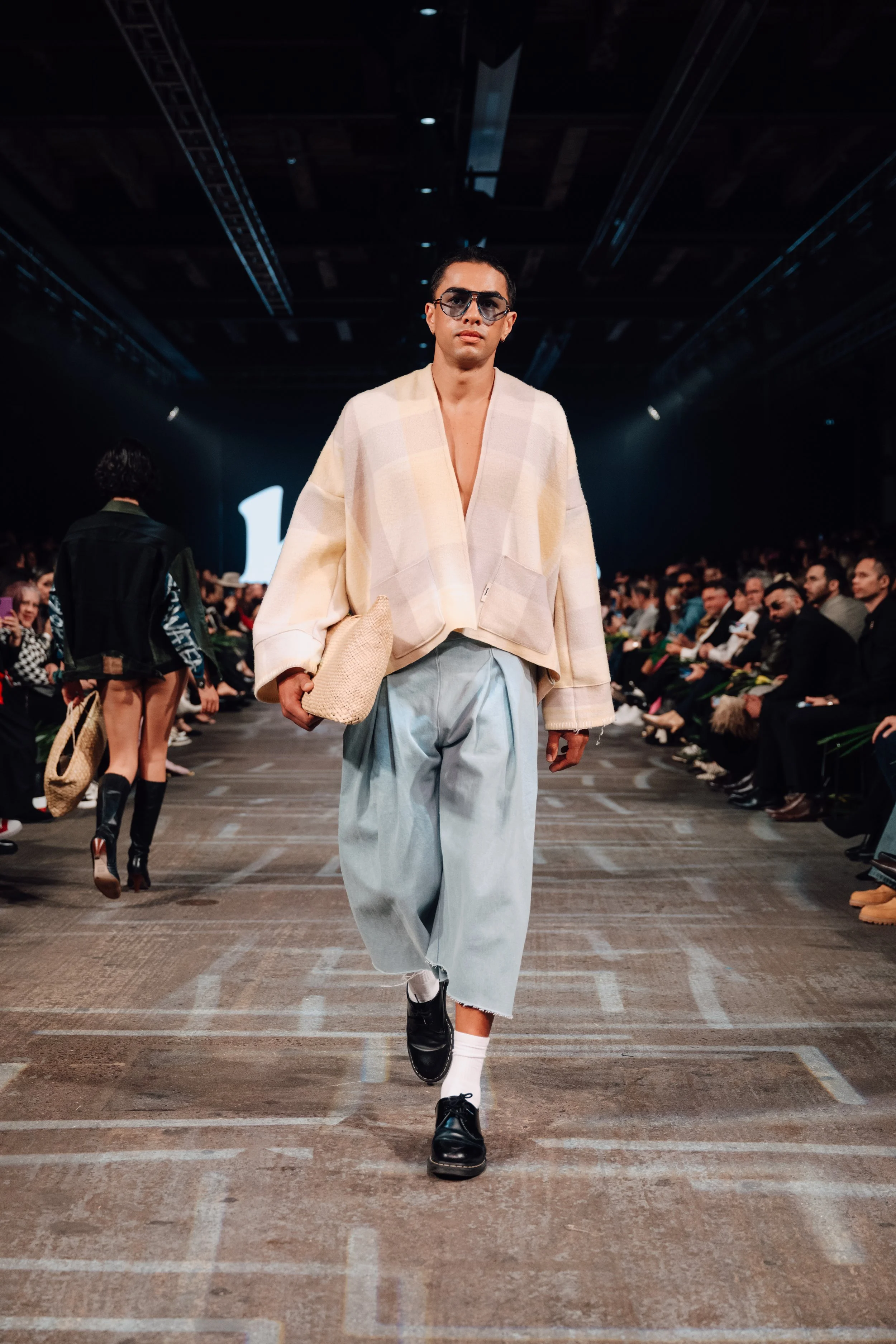
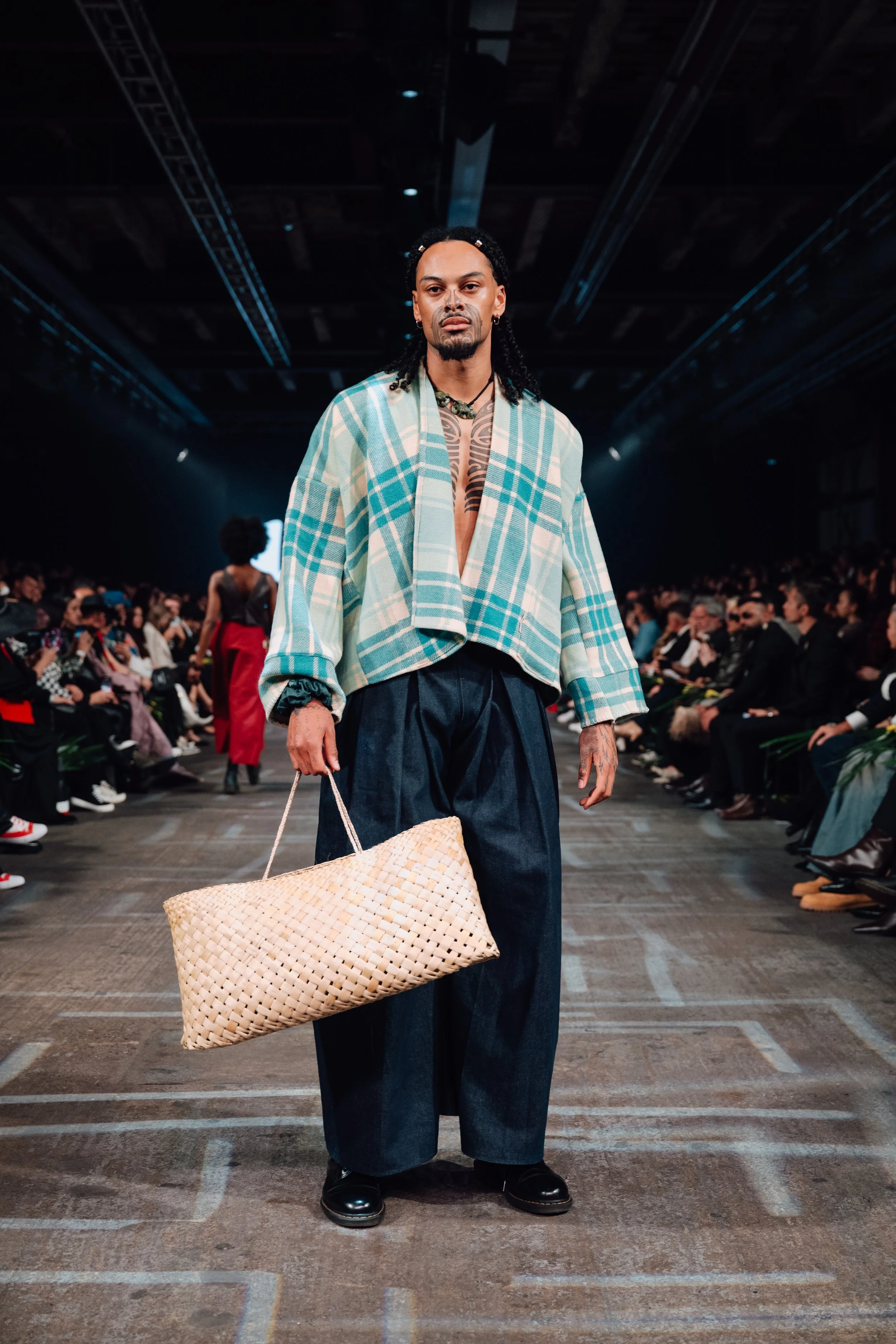
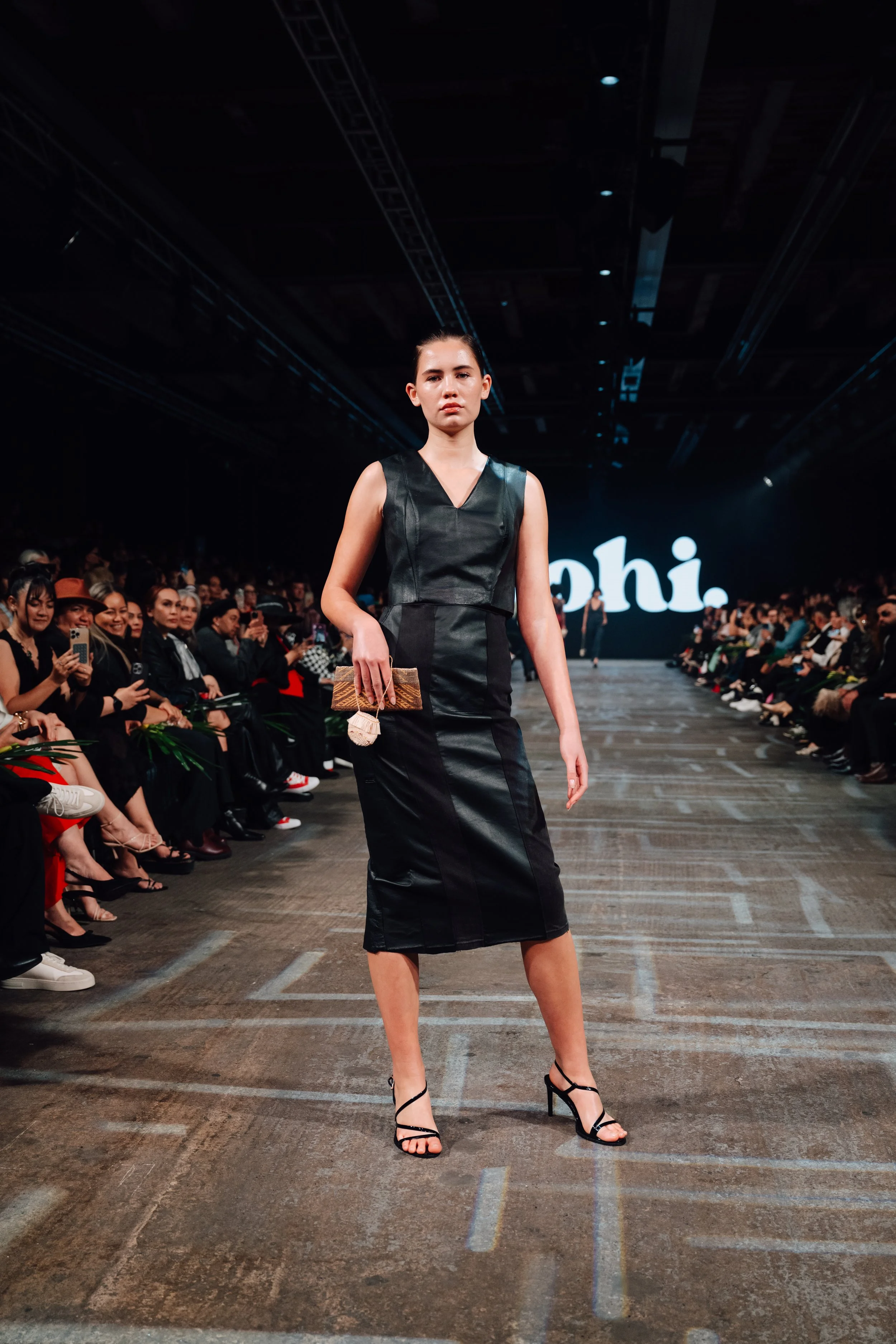
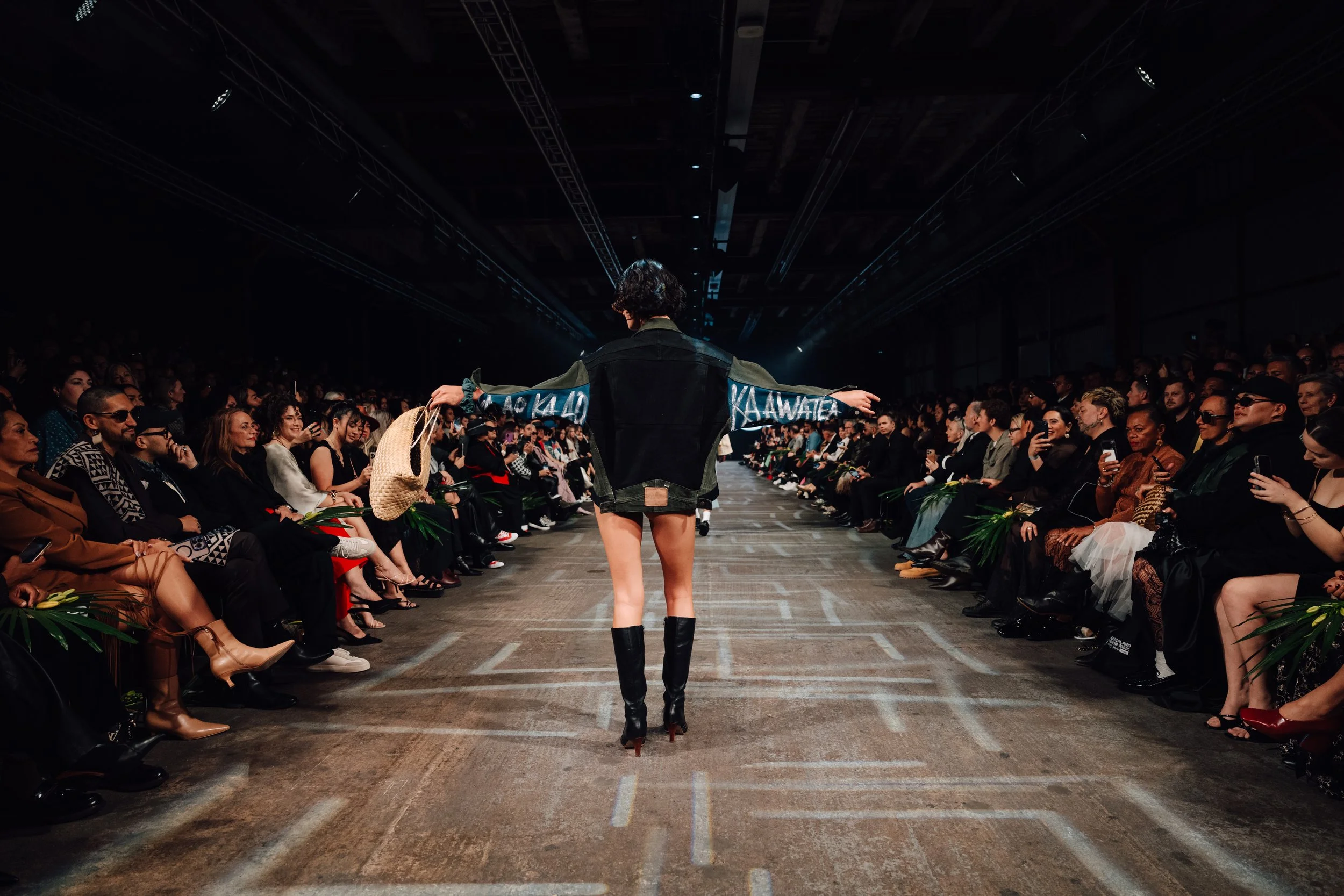
Internationally acclaimed Māori designer Kiri Nathan (Ngāpuhi, Ngāti Hine, Ngāti Maru, Ngāti Hauā, Ngāti Paoa) founder of Kāhui Collective, produced two landmark Indigenous fashion events during NZ Fashion Week Kahuria 2026. The Kāhui Collective Runway and inaugural NZ Indigenous Fashion Symposium united designers, artists, cultural practitioners, and industry leaders from Aotearoa, the Pacific, and beyond.
Included in Kāhui Collective Runway, KOHI by Kohi Woodman (Ngāpuhi, Ngāti Whātua, Te Arawa) presented a collection that was conceptualised and crafted in Kaikohekohe. Using recycled textiles such as denim, woolen blankets and leather, the kakahu presented offered thoughtful design grounded in sustainability. Pairing looks with kete whakairo by Rebecca Toki, KOHI showed us that contemporary indigenous fashion need not stray far from the pukenga of home.
The week-long celebration highlighted indigenous creativity, innovation, and commerce, positioning Aotearoa at the forefront of southern hemisphere Indigenous fashion leadership. The events created vital opportunities for collaboration, trade, and storytelling. Both initiatives were community-operated. Nathan invited whānau and supporters to volunteer their time to manaaki and deliver these kaupapa
SPOTLIGHT
AKO HOKIANGA
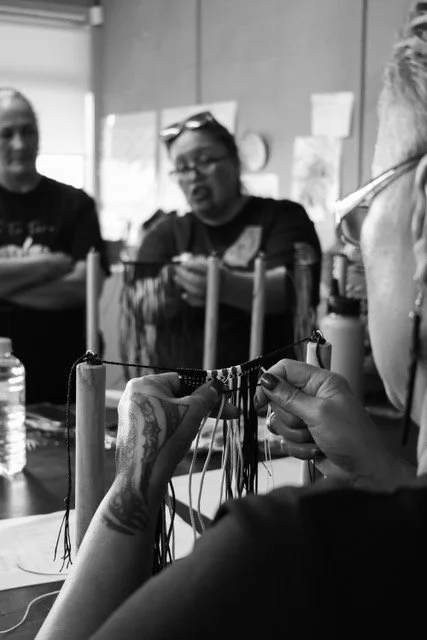
Based at the historic Northtec Rawene Campus in Hokianga, Ako Hokianga demonstrates that the arts are a powerful engine for community wellbeing. As the arts arm of the Hokianga Community Educational Trust (HCET), the organisation delivers affordable, locally-led arts and IT workshops designed to upskill, empower, and connect the hapori of Hokianga.
Looking ahead, Ako Hokianga is developing a three-year rangatahi project. This kaupapa will begin with short courses and build toward mentorships and enterprise pathways. Conversations are underway with Hokianga schools to create an online platform where students can share creative work, with potential for collective publication. A print-making space is on the drawing board in partnership with Quarry Arts Centre Whangārei, a writers' festival is planned for 2027, and jewellery workshops remain firmly on the wishlist.
To find upcoming courses or join the database, visit akohokianga.org.nz, or follow @ako_hokianga on Instagram and Ako Hokianga on Facebook.
-
HCET was founded in 2003 with a focus on community, film and book festivals, alongside its publishing arm, Hokianga Publishers, which now boasts a catalogue of ten titles. But a turning point came in 2021, when HCET successfully campaigned to return the disused Northtec campus in Rawene to the community after five years of closure. That victory reshaped the trust's focus, catalysing investment in arts coordination, programming, and ultimately the birth of Ako Hokianga.
Today, the programme revolves around two fundamental pillars: uku (clay) and kōhatu (stone). Stone carving is taught across three tiers in a revolving course: beginner with Eva Walker, intermediate with Laurence Hale, and a master's class. Kristina Robertson leads uku, alongside visiting Te Tai Tokerau practitioners. Yet the programme remains deliberately fluid, responding directly to what local communities asks for. Past and present offerings include taonga pūoro, bone carving, tapestry, appliqué with Ron Te Kawa, printmaking with Faith McManus, tukutuku, collage, poetry writing, and jewellery making.
At the heart of Ako Hokianga's kaupapa is a commitment to whakawhanaungatanga and mahitahi. Crucially, the workshops are not assessment-driven. Participants can engage at whatever level suits them, removing barriers and centring hauora above all else. Multi-talented coordinators, Simi Paris and Haley Gielen shape the programme together with the HCET komiti, ensuring it stays grounded to the needs of Hokianga communities.
OUR PARTNERSŌ MĀTOU KAITAUTOKO
CORE FUNDING PARTNER

In 2019, Creative New Zealand (CNZ) formed a partnership with Toi Ngāpuhi.
Creative New Zealand encourages, promotes and supports the arts in New Zealand for the benefit of all New Zealanders through funding, capability building and international programmes and advocacy.
PRINCIPAL FUNDER
